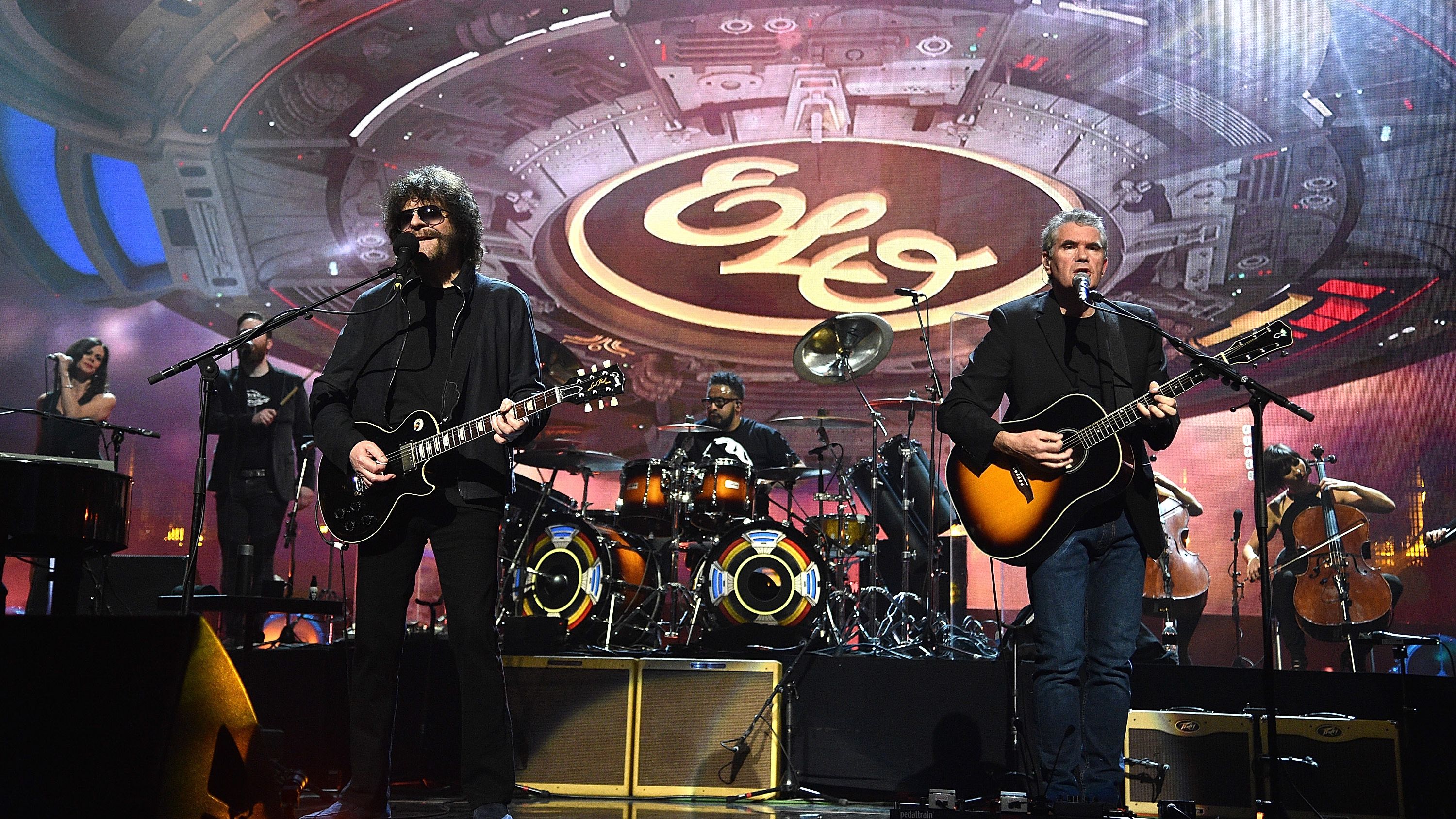
Lets look at The Electric Light Orchestra, and the history of its main member Jeff Lynne is one of those rock stories that becomes more fascinating the closer you look. Many people know the band for huge radio favorites like “Telephone Line,” “Mr. Blue Sky,” and “Don’t Bring Me Down,” but the real story reaches back to Birmingham, England, and to a bold musical idea: what if a rock band could pick up where the Beatles’ more adventurous studio work left off? That ambition gave the world Electric Light Orchestra, usually shortened to ELO, a group that blended pop hooks, classical textures, and studio imagination into one of the most distinctive sounds of the 1970s.
To understand ELO, it helps to start with the band that came before it: The Move. In the late 1960s, The Move was a successful British group led by Roy Wood, with a reputation for sharp songwriting, strong musicianship, and inventive pop-rock records. The Move went through several lineup changes, but among its key figures were Roy Wood, Bev Bevan, and eventually Jeff Lynne. The connection between the two bands is essential, because ELO did not appear out of nowhere. It grew directly out of the ambitions of members of The Move who wanted to push their music into new territory.
Roy Wood was especially important in shaping that next step. He had become increasingly interested in combining rock instruments with orchestral sounds, not just as decoration but as a central part of the music. This was not a casual thought. It was tied to the same wider shift in pop music that had inspired so many artists after the Beatles changed expectations of what a band could do in the studio. Albums and songs could now be cinematic, layered, and experimental while still being catchy. In that atmosphere, Wood began imagining a group that would use cellos, violins, and complex arrangements as part of its core identity.
![]() |
![]() |
The Beatles’ influence, especially the spirit surrounding Sgt. Pepper’s Lonely Hearts Club Band, hangs over the birth of Electric Light Orchestra in a very real way. The idea was not to imitate the Beatles exactly, but to continue the adventurous path they had opened up on records like “Strawberry Fields Forever,” “I Am the Walrus,” and the Sgt. Pepper album. Those recordings showed that pop could be ambitious, surreal, melodic, and richly orchestrated all at once. ELO’s founding concept is often described as an attempt to carry on from where the Beatles had left off, particularly in their more orchestral and studio-based work
Jeff Lynne entered this story with his own strong musical background. Born in Birmingham in 1947, he grew up deeply influenced by rock and roll, skiffle, and especially the Beatles. Before joining The Move, he had been in bands including the Idle Race, where his gift for melody, harmony, and studio-crafted pop was already obvious. Even then, Jeff Lynne was developing the qualities that would later define him: a love of layered sound, a knack for writing unforgettable choruses, and a producer’s ear for detail. He was not just a guitarist or singer; he was a musical architect in the making.
Lynne was invited to join The Move in 1970, and that turned out to be a key moment in rock history. Roy Wood had wanted him in the group earlier, admiring his talent, and once Lynne finally came aboard, the chemistry helped push the idea of Electric Light Orchestra into reality. At first, The Move and ELO existed side by side for practical reasons. The Move was still the more established name and could help fund the newer, riskier project. That overlap sometimes confuses newcomers, but it makes sense when you see ELO as an evolution rather than a clean break.

The original Electric Light Orchestra Members at the start included Roy Wood, Jeff Lynne, and drummer Bev Bevan, with other musicians brought in to handle the expanded sound. The challenge was immediate: it is one thing to imagine a rock band with classical instruments, and another thing entirely to make it work on stage and in the studio. Early ELO was rougher, stranger, and more experimental than the sleek hit-making machine the band later became. But that early period matters, because it captured the excitement of artists trying to invent a new sound from scratch.
ELO’s first album, released in 1971 in the UK as The Electric Light Orchestra, introduced that unusual concept. In the United States, it later appeared under the title "No Answer" because of a misunderstanding involving a phone call to the label, a small bit of music-business confusion that became part of the band’s history. The album featured dramatic arrangements, heavy cello presence, and a mix of psychedelic ambition and symphonic rock. It was not yet the polished ELO most casual listeners know, but it clearly announced that this was a group with a big vision.
One song from that debut, “10538 Overture,” became the first notable ELO hit and remains a wonderful example of the early style. It has churning strings, a haunting mood, and the sense that pop songcraft is being stretched into something grander and more eccentric. Not long after the first album, however, Roy Wood left the group. He went on to form "Wizzard", another colorful and inventive band. His departure could easily have ended ELO before it had fully begun, but instead it opened the door for Jeff Lynne to become the main creative force.
This change was decisive. From that point forward, Jeff Lynne became the band’s principal songwriter, producer, lead singer, and musical director. That level of control gave ELO a stronger identity and a more unified sound. Lynne had the rare ability to write songs that felt both sophisticated and immediate. He loved lush arrangements, but he also understood the power of a simple melodic hook. As the 1970s moved on, he guided ELO from an intriguing experiment into an international success story.

The early 1970s albums showed that progress step by step. ELO 2 expanded the group’s scale and ambition, even including a striking version of Chuck Berry’s “Roll Over Beethoven” that linked rock history to orchestral drama. On the Ballad of Big Blue and On the Third Day, Lynne continued refining the balance between classical flourishes and accessible pop-rock structure. These records may not be as widely known as the later blockbusters, but they are where the essential ELO style took shape: sweeping strings, stacked harmonies, pounding rhythms, and songs built for both headphones and arenas.
![]() |
![]() |
By the mid-1970s, the band had truly found its stride. The albums Eldorado and Face the Music were major advances, showing Jeff Lynne growing more confident as both writer and producer. Eldorado was a concept album with a dreamlike quality, and it gave ELO a richer, more cinematic profile. Face the Music brought a sharper, punchier approach and helped establish the band in the United States. Songs such as “Evil Woman” revealed just how effective Lynne’s formula could be: elegant strings, strong beat, irresistible chorus, and just enough eccentricity to keep it interesting.
Then came A New World Record in 1976, the album that turned ELO into one of the defining pop-rock acts of the decade. It contained a run of songs that still feel instantly familiar: “Livin’ Thing,” “Telephone Line,” “Rockaria!,” and “Do Ya,” the last of which had roots in The Move. “Telephone Line” in particular became one of the band’s signature songs, a beautifully crafted piece of melancholy pop with lush production and a deeply memorable vocal from Lynne. For many listeners, this is where the magic of ELO fully clicked into place.
If A New World Record made them stars, Out of the Blue in 1977 made them giants. This double album is packed with ELO landmarks, including “Turn to Stone,” “Sweet Talkin’ Woman,” “Wild West Hero,” and of course “Mr. Blue Sky,” one of the most joyful and enduring songs in popular music. The record captured Jeff Lynne at a peak of inspiration, turning his Beatles-influenced sense of melody into something that sounded completely his own. Out of the Blue also helped cement the visual side of ELO, with its famous spaceship imagery becoming a lasting symbol of the band.
Live performance was always a challenge for a group with so many layered sounds, but ELO turned that challenge into part of its appeal. Their concerts became major productions, featuring elaborate staging and the sense that audiences were seeing a futuristic pop spectacle. At a time when arena rock often leaned on raw force, ELO offered something different: precision, color, theatricality, and songs that balanced grandeur with warmth. That helped the band stand apart from both progressive rock acts and more straightforward chart pop groups.
Another major success arrived with Discovery in 1979, which included “Shine a Little Love,” “Last Train to London,” “Confusion,” and “Don’t Bring Me Down.” That last song is particularly interesting because it became one of ELO’s biggest hits while relying less on the string-heavy style many people associated with them. It showed that Jeff Lynne was never trapped by the original concept. He could streamline the sound when he wanted to, keeping the polish and melodic strength while shifting toward a more direct, punchy rock-pop approach.
As the 1980s began, ELO continued evolving. The soundtrack album Xanadu, made with Olivia Newton-John, produced another major hit with the title track, although the film itself received a mixed response. Then came Time in 1981, a science-fiction-themed album that many fans now rank among the band’s finest works. It leaned more heavily into synthesizers and modern production, proving again that Lynne was willing to adapt. Secret Messages and Balance of Power followed, but by then the musical climate had changed, and the band’s classic imperial phase was nearing its end.
Over those years, the lineup changed often, which is why readers curious about Electric Light Orchestra Members can sometimes find the history a little complicated. Bev Bevan remained an important presence for much of the classic era, and musicians such as Richard Tandy became vital to the band’s sound, especially through keyboards and arrangements. Kelly Groucutt also played an important role during the successful 1970s period. While ELO was very much Jeff Lynne’s vision in its mature form, it was still brought to life by talented collaborators whose playing and performances mattered greatly.
Jeff Lynne’s story after the classic ELO era is almost as impressive as the band’s rise. He became one of the most respected producers in popular music, working with major artists including George Harrison, Tom Petty, Roy Orbison, and others. His crisp, layered production sound became instantly recognizable. He was also a member of the Traveling Wilburys alongside Harrison, Petty, Orbison, and Bob Dylan, a remarkable supergroup that reflected how highly he was regarded by fellow musicians. For anyone exploring The topic is The Electric Light Orchestra, and the history of its main member Jeff Lynne, this later chapter confirms just how influential he became beyond Electric Light Orchestra itself.

One especially pleasing twist in Lynne’s career is that his Beatles connection eventually became direct rather than just inspirational. He worked closely with George Harrison, produced for members of the Beatles circle, and later was involved in the Beatles reunion-era recordings “Free as a Bird” and “Real Love,” which were built from John Lennon demos. For the Birmingham boy who had been inspired by Sgt. Pepper and the Beatles’ studio imagination, that was a remarkable full-circle moment. It also underlined the fact that Jeff Lynne was not simply a fan carrying a torch; he had earned a place in that wider musical legacy.
ELO’s legacy today is strong because the songs have lasted. “Telephone Line” still sounds tender and richly human, “Don’t Bring Me Down” still hits with pure energy, and “Mr. Blue Sky” still feels like bottled sunshine. The band’s mix of orchestral color and pop clarity influenced many artists who came later, even if they did not sound exactly like ELO. Modern listeners can hear in their records a bridge between 1960s studio experimentation and later polished pop production. The topic is The Electric Light Orchestra, and the history of its main member Jeff Lynne remains compelling because it is really about vision, persistence, and the joy of making ambitious music feel wonderfully accessible.
In the end, Electric Light Orchestra was far more than a band with a few classic radio songs. It was the result of a daring idea born from The Move, shaped first by Roy Wood and then developed brilliantly by Jeff Lynne into one of the most recognizable sounds in rock and pop. Their history includes experimentation, reinvention, commercial triumph, and a deep connection to the Beatles-inspired dream of expanding what popular music could be. Once you know that background, those familiar songs open up in a new way, and it becomes much easier to appreciate why ELO and Jeff Lynne still hold such a special place in music history.
Enjoy this site? Share with friends!